

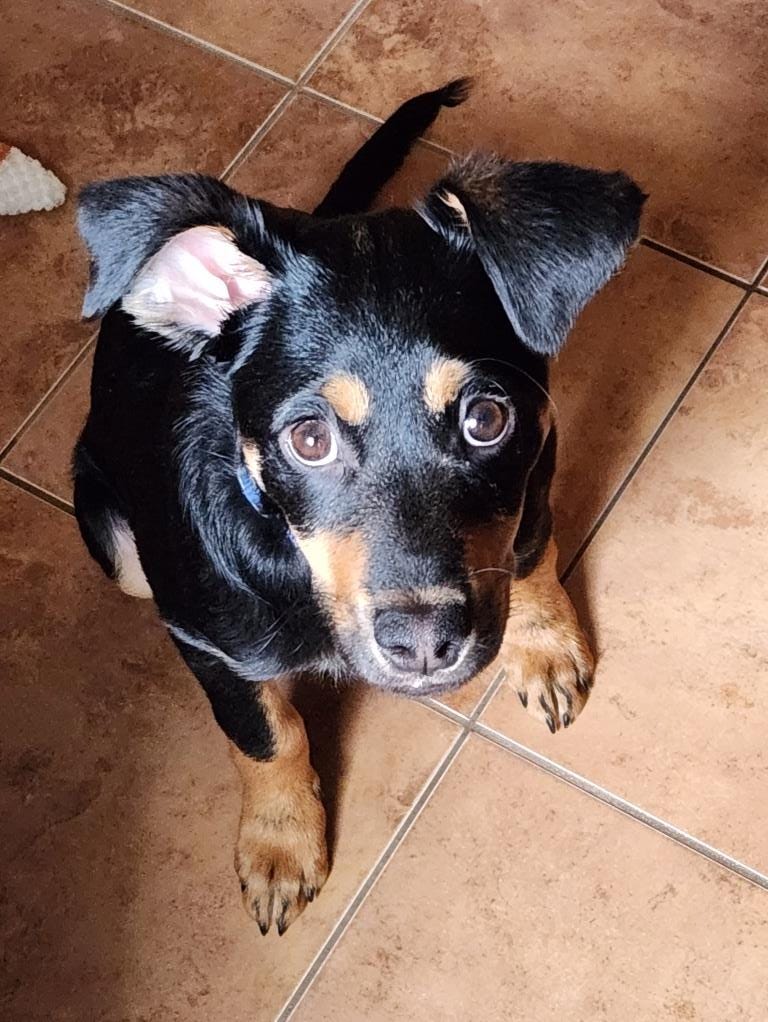
I just got a face wash from an eager 4-month-old puppy who has been with me since Mother’s Day May 15. Given how she uses her mouth to taste the world, that may be a boon to my somewhat more sterilized biome. She was rescued from Puerto Rico, one of seven abandoned puppies. She filled a hole when I reconciled myself to my cat being gone.
And then my cat came back.
I drove from Arlington, Virginia June 17 back to the farm in Indiana two months after his disappearance to re-rescue my cat, who went missing Thursday evening April 13, 2023 out the front porch door of the farmhouse. I spotted a brown lump in the field when I arrived late Saturday night. Then Sunday morning, he showed up on the front porch, jumped in my lap, and shocked and appalled me with his appearance. When someone opened the door later that day, he saw an opening and raced upstairs to the bedroom territory he had previously claimed as his, reclaiming it whether we wanted him to or not.
Filthy, with matted fur, scabbed and scratched all over, covered in burrs and ticks, bony, he was so skinny that he was down to 8 pounds from 13. Diseases unknown. He must have had some success as a hunter (thankfully with claws intact). But, equally, he was potential prey out hunting in the dark of night. I had figured the odds were stacked against him in coyote and bobcat territory, a particular target as a male. The stray pit bull mix I found chasing something down by the creek when I was looking for Jordan would have torn him to shreds if he’d caught him.
After his walk on the wild side—because he decided he preferred his domestic life, needed help, or finally figured out how to get home—Jordan was eager to jump back into being a kept animal. My cat had great equanimity switching from pampered pet to wild and back. As a human, some equanimity is hard for me. I learn a lot from nature and my animals. My cat had walked that knife edge between life and death and dropped his conclusions at my feet like a gift mouse.
Having chosen the civilized life, Jordan submitted to necessary nursing. I immediately gave him flea and tick medicine, as well as food and water, and started herbs to bind with heavy metals (from wandering through herbicide-sprayed fields). I gave him half a bath with medicated shampoo I’d brought with me.
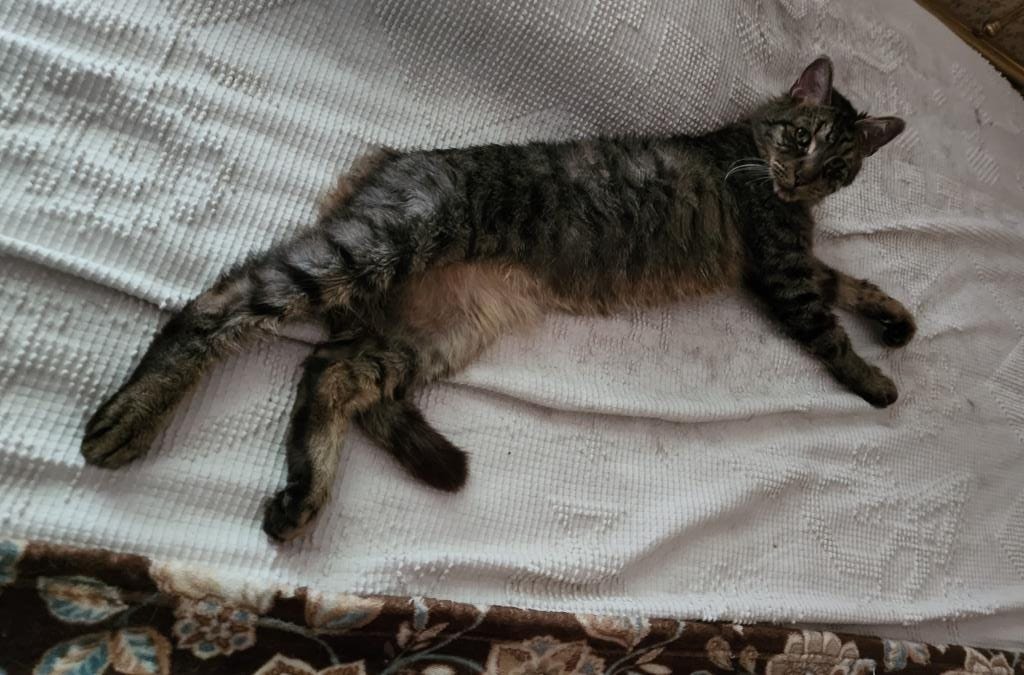
At the vet’s the next day, Monday, he got a different type of flea and tick medicine for already-embedded ticks and a dewormer. We pulled maybe 15 ticks off him. Tests revealed hookworm parasites and an infection of the urinary tract, necessitating a trip back for antibiotics. The vet recommended brushing him with a wire brush to get rid of the matted hair (pull it out) rather than a bath to clean it up.
I gave over the upstairs bedroom he claimed, slept in a twin bed in the bedroom opposite, quarantined him from the puppy and my 14-year-old beagle-border collie mix, and started treating the ailments one by one to bring him back from cat wilded to pampered pet. It was not clear he could be brought back to health. His physiology was at a fragile place. I pumped him up with chemicals. He started throwing up on Saturday, maybe from the antibiotic. And he didn’t gain back the weight immediately.
Jordan was not the only cat hanging around the farm seeking rescue. Most of the cats around here are barn cats—well, the lucky ones—and that appalling appearance is status quo. My grandfather used to feed the barn cats milk while he was up at the barn working with the cows. Malnourished, infected, parasite-infested is the life for wild cats or farm cats.
We live a little closer to life and death here on the farm than in the city. I am surrounded by life and also dead beings every day. There seems to be a balance of new and old. Farm ethic: to take resources on the farm, creatures have to provide value. Barn cats get fed because they control mice. (Jordan killed three mice in the farmhouse.) Ground hogs get shot if spotted on the farm because they undermine building foundations with their tunnels. My grandfather used to pick up black snakes with a pitchfork and toss them into the corn crib to eat mice. I have a soft spot for ‘possums because they are voracious tick predators.
Here on the farm, it’s a dramatic disjunct between the pampered life pets enjoy in Arlington, Virginia and the hard-scrabble survival of unwanted or wild animals in the country. Friends and family buy toys and costumes to keep their pets (and their owners) entertained, have dog parties, go to pet events, treat their pets to baths and grooming to meet civilized standards of cleanliness and so they look their best for socializing. Out here, as elsewhere, people’s aversion to or careless unconcern about neutering animals—or lack of resources to do the right thing—means a very low level of existence for unwanted animals, who often end up as road kill. But who am I to judge. Is any kind of existence—a free, vagabond existence—life, and therefore good?
That seems to be the argument some people are making to ban abortions in states across America. (Contraception is also in the target hairs of the Supreme Court, Justice Clarence Thomas has let us know.) Any life—unwanted, impoverished—and the lives it takes with it, is good.
Out here on the farm, life is a struggle—oh, not in general. In general, life proliferates prodigiously. But in specific, individual lives, nothing is guaranteed from day to day. And the sacrifice of parents to try to protect the young is key to their survival. Even grandparents, it has been shown, are important to the thriving of young. A lot of community resources go into bringing on the next generation.
Let’s get a little clinical. Only 10 to 20 percent of songbird eggs ever result in an adult bird. The eggs might not incubate or might get eaten by predators. Weather might blow the nest out of the tree or the young might starve.1
Narrowing in on one species, on average only 40 percent of robin nests produce young come spring. Only 25 percent of fledglings survive to the fall. Of the 10 percent survivors, only half will live to see the next year from then on.2

Closer to home, although doctors seem less capable of figuring out survival rates in a species that should be infinitely easier to measure, the odds are still stacked against surviving. In humans, “at least 73% of natural single conceptions have no real chance of surviving 6 weeks of gestation. Of the remainder, about 90% will survive to term.”3 (We’ll leave aside “failure to thrive” once a live birth happens. I also have a rescue daughter, adopted from Russia.)
Death is part of life. In fact, like the void of space that surrounds our gentle, blue planet, death is the sea in which life swims. Life takes courage (and has the promise of joy). Jumping in is a complicated decision for complicated humans.
For complicated humans, 73 percent spontaneous abortion or nonviable pregnancy is the largest part of the system compared with birth. That’s the system. That’s God’s will, if you will. You can wish it were different, but you can’t wish it away. As politicians try to legislate it away, we’re seeing mothers not being able to get the care they need when they need it.
Maternal death, already high in America compared with other “developed” countries, and even some “less developed” countries, is rising. (The maternal mortality rate for 2021 was 32.9 deaths per 100,000 live births, compared with a rate of 23.8 in 2020 and 20.1 in 2019.4) We’re moving closer to the animal part of the scale again, away from civilized. Why? Because we’re trying to impose human will over larger natural forces instead of working toward improving human outcomes in alignment with the larger forces of life and its realities. That would be “pro-life.”
Hoyert DL. Maternal mortality rates in the United States, 2021. NCHS Health E-Stats. 2023.
DOI: https://dx.doi.org/10.15620/cdc:124678.
Best wishes with Jordan's recovery, Linda. And thanks for reminding us not to kiss you when your puppy has swabbed your face with cat poop!
While I am personally against the idea of abortion in most cases where the mother and fetus are healthy, it's none of my business what a woman does with her own body. In my view, that decision is completely up to the mother and her doctor, ideally with caring input from family and loved ones. It should not be left up to meddling (mostly male) politicians who have adopted their stance to generate social media clicks and rile up a base that doesn't represent the majority of Americans in the first place.