

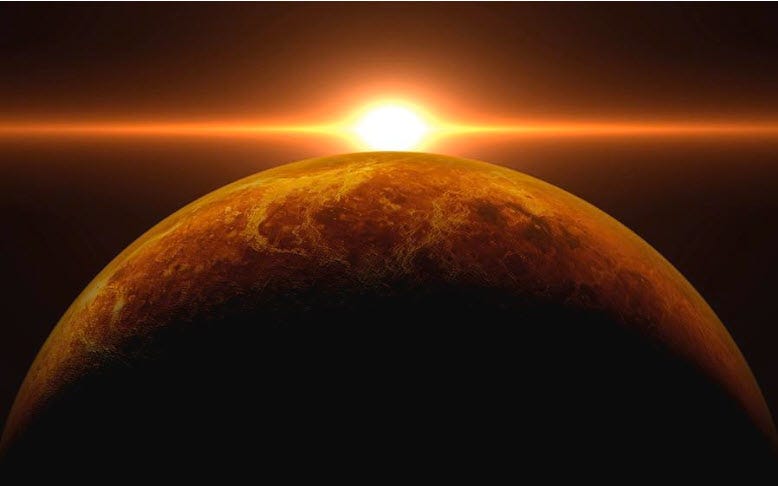
I did not know that on Venus days are longer than years. Venus spins on its axis so slowly that it takes 243 Earth days for it to spin on its axis, but it takes 225 Earth days for Venus to go all the way around the Sun. So that's its "sidereal" day. But because Venus spins backwards to its rotation around the Sun, it's "solar" day, how long it takes the Sun to return to the same spot in the sky, is 117 Earth days. So while on Earth, sunrise happens once each day, on Venus it rises more than once a (Venus) day. Also, the Sun rises in the West on Venus.
Why Venus Time Works This Way:
Spin time (Sidereal day): Takes 243 Earth days to turn once.
Orbit time (Year): Takes 225 Earth days to go around the Sun.
Sunrise cycle (Solar day): Takes 117 Earth days between sunrises.
Direction: Spins backward, so the Sun rises in the west. [1, 2]
Also, its axis only has a 3-degree tilt. So, basically it has no seasons.
Hard to imagine what a day-in-the-life looks like on Venus, but very different from days on Earth! So on Venus, you have to wait a long time between day and night. You have no change in seasons. Basically no change, ever, in temperatures that are always boiling. The air is noxious. Venus approaches closer to Earth than any other planet (although Mercury is closer over time.) Our closest planet. Want to switch places?
Another reason to appreciate life on Earth--even over our nearest neighboring planets!
You remind me of the wonderful narration by Sir Cedric Hardwicke, introducing planets of the solar system in the opening scenes of the 1953 film, "War of the Worlds." This short video has been enhanced with some updated NASA images.
https://www.youtube.com/watch?v=GUvNcXkqMaE