
Trump Decoded
I'm starting to understand the messages of the far right, and they tap into some of my fears, too.


Be careful of getting hung up on Trump’s abuse of the language. It’s the messages underneath the messages that are the real killers that grab you by the gut and make you afraid on a visceral level that the life you aspired to is slipping out of your reach. That may be true, but the reasons have little to do with the arguments and promises of the campaigns.
When Trump accuses Harris of being a socialist and a Marxist, we on the left get hung up on the correct meaning of the words and how they’re inappropriate. But what Trump is doing is redefining them for his own purposes. What the right means when they says “socialism” is throwing the hoard of taxpayer money at social problems instead of supporting industry and growing the economy.
Look at the implications of his redefinitions. “Marxism”—“Robin Hoodism,” taking from the rich to give to the poor. “Rich”—anyone who has a good-paying job in our wealthy country and aspires to get ahead. “Poor”—blacks, “Welfare mothers,” immigrants, the lazy, people who don’t work or aren’t as accomplished, who are a burden on society. It’s not clear whether that includes “the old.” Sometimes it does. Sometimes it doesn’t. You don’t really want to say that out loud—maybe other people’s unwanted elders, not your elderly mother. This message taps into the fear that despite your best efforts, you’re not getting ahead. Some external force is responsible. You’re being dragged down by taxes and government regulation—rules that slow down the producers for the benefit of the hangers on and slackers. You’re bearing more of a burden for society than your fair share. In the wake of a pandemic, I imagine we all feel some of the burden of recovery that was out of our control.
When Trump went in front of black journalists and claimed Kamala Harris used to be Indian and now was Black, it was ridiculous on the face of it. But it wasn’t so much that she had changed as that Trump now wanted to label her as Black, rather than Indian, from when he actually supported her campaign. Indians are an ethnic minority that—so far—do not have a negative association, perceived as accomplished, integrated, and contributing to our society. But that could change, Asians used to be perceived that way until they started to be perceived as outcompeting non-Asian Americans, and it changed. Labelling Harris Black, in a message that was widely broadcast on both sides of the divide for different reasons, clearly put her on the side of championing the interests of “the poor” over the producers.
But Trump might be able to save the American Dream for some of you—critically—not all. His vision, which makes perfect sense for his family and business background, is a zero-sum game. For you to have what you want, some people are going to have to go without—the unworthy ones. This echoes some of the messages of those who owned slaves before the Civil War. It’s a human tendency that doesn’t go away, but isn’t actually sustainable or as productive in the long term. There’s a large cost to keeping a segment of the population down, an even larger cost to deporting them, and a cost to losing low-income labor.
These messages are visceral messages. They are difficult to reach with reason, and they work when you feel insecure. We need some evidence that lifting the least among us lifts all boats rather than sinking the ship.
“If you don’t fight like hell, you won’t have a country anymore.” For people “normalizing” Trump, this is not taken literally. It means that now is the time to fight dirty, if you have to, to beat back this overreach by the Government, particularly in Washington, or you won’t have the America you aspired to raise your children in. The crazies and militias in Trump camp take it literally. We saw that on January 6. And many people on the left take it literally. I’ve heard gun owners (former military) on the left say they’ll take out their guns for a contested election, assuming there will be violence from the right. There are people for whom the life and death power of an easily obtained gun gives them a sense of power that nothing else does.

Giving $6,000 in tax credits to new families isn’t free. I certainly agree that new families are a better investment of tax dollars than oil and gas companies. We have a long ways to go to at least give a tax break, if not invest, in children instead (and this is in the tax code—look it up) of race horses. But you have to break the hold on the corruption of our tax code to solve that problem. You have to address the problem of politicians being bought by money interests—enabled by the Supreme Court “Citizens United” decision—to solve that problem. Otherwise, you’re just adding to it.
When the Dems say they’re going to cap insulin and prescription drug costs, who’s going to pay to relieve those burdens on those who use a lot of prescription drugs every day? I have always appreciated that I pay more insurance so others, who have received a cancer diagnosis, for example, don’t bear the burden alone. But the insurance companies don’t absorb the burden for those policies, consumers do. It feels unfair (in much the same way as taxes) when the burden feels too heavy. In the case of health care, I mostly don’t use the western medical system. I try to focus on plant-based foods and regular exercise and fresh air. But, particularly now that I am in the Medicare system, I will be supporting a health care system focused on disease, not those of us who are healthy and careful with our health choices and decisions. I haven’t analyzed the new health insurance premiums coming out during this open enrollment period and with the Inflation Reduction Act going into effect January 2025. I suspect, though, that the drug companies aren’t absorbing those costs.
Same goes for the $25,000 to new business. That’s good social engineering, but what’s the plan for where that money comes from? The taxpayer? If your plan is to make the wealthy “pay their fair share,” how are you going to do that? Raising the interest rates on business income seems like a weak strategy. How does raising the interest rate on a group of folks who use the tax loopholes to pay no taxes help? It gets back to the exceptions that companies direct their representatives to put into the tax code to benefit them. I incorporated as a Subchapter S company so I could relieve the tax burden on my small company. That business structure was so advantageous over the straight income tax that employees pay that it enabled me to establish retirement for myself.
What is the solution? Addressing corruption. For example, get some money to the GOP-starved IRS. The return on investment to that small agency is a whopping 600 percent. With a little money, they have been able to retrieve vast sums from tax cheaters. That is fighting corruption—holding tax cheaters to the same rules as the rest of us and making the system work for everyone. If you break the rules you pay, not profit. Trump exemplifies profiting from breaking the rules for him and his cronies. Most Americans just want a level playing field. They want everyone to play by the rules as long as they feel like the rules are not rigged—that they’re agreed upon by people of good faith. Business structures really already give new businesses a big break. Go after the companies that took advantage of the COVID payroll money sent out by the Government, who scammed the taxpayer—huge amounts of money because the GOP hamstrung check-and-compliance protections in the bill.
Stop the many ways cheaters feed off the trough of federal money. Go deep into the structures and make those automatic lanes flow in ways that work to encourage new growth and make those who have profited contribute to the community they have benefited from. In other words, incentivize companies to be good citizens and support the community that supports them. We are already structured to indemnify business losses. (Bankruptcy: we all pay for that.) But we let winners take all as their reward. Corporations that declare bankruptcy can turn around and profit in other sectors. Worse, corporations like the Trump Corporation profit unfairly and then use their power to pull up the ladder to eliminate competition by getting the Congress to put obstacles in the way for less established players in the market.
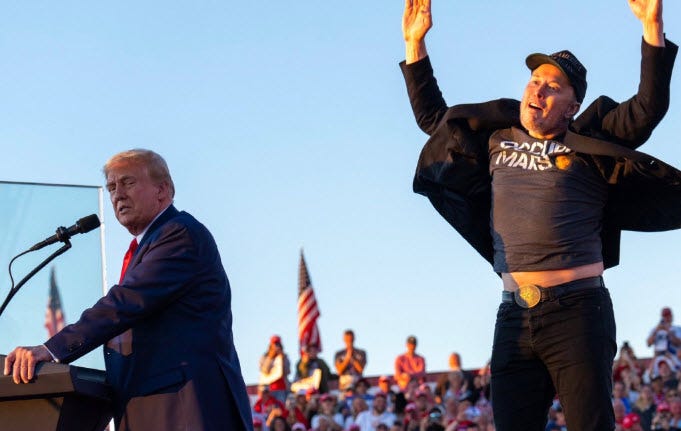
Free market? Oh boy, where does one start. There’s nothing free about GOP proposals, just a fight for who gets to “distort” the market and in what ways. Dems generally try to “distort” the markets in service of clean air and water and to protect consumers. The corruption of the GOP party has led to the kind of cronyism we see with Trump. He is courting the favor of the richest of the rich (Elon Musk), their wealth and power to help him win, with promises to clear the way for them to get richer.
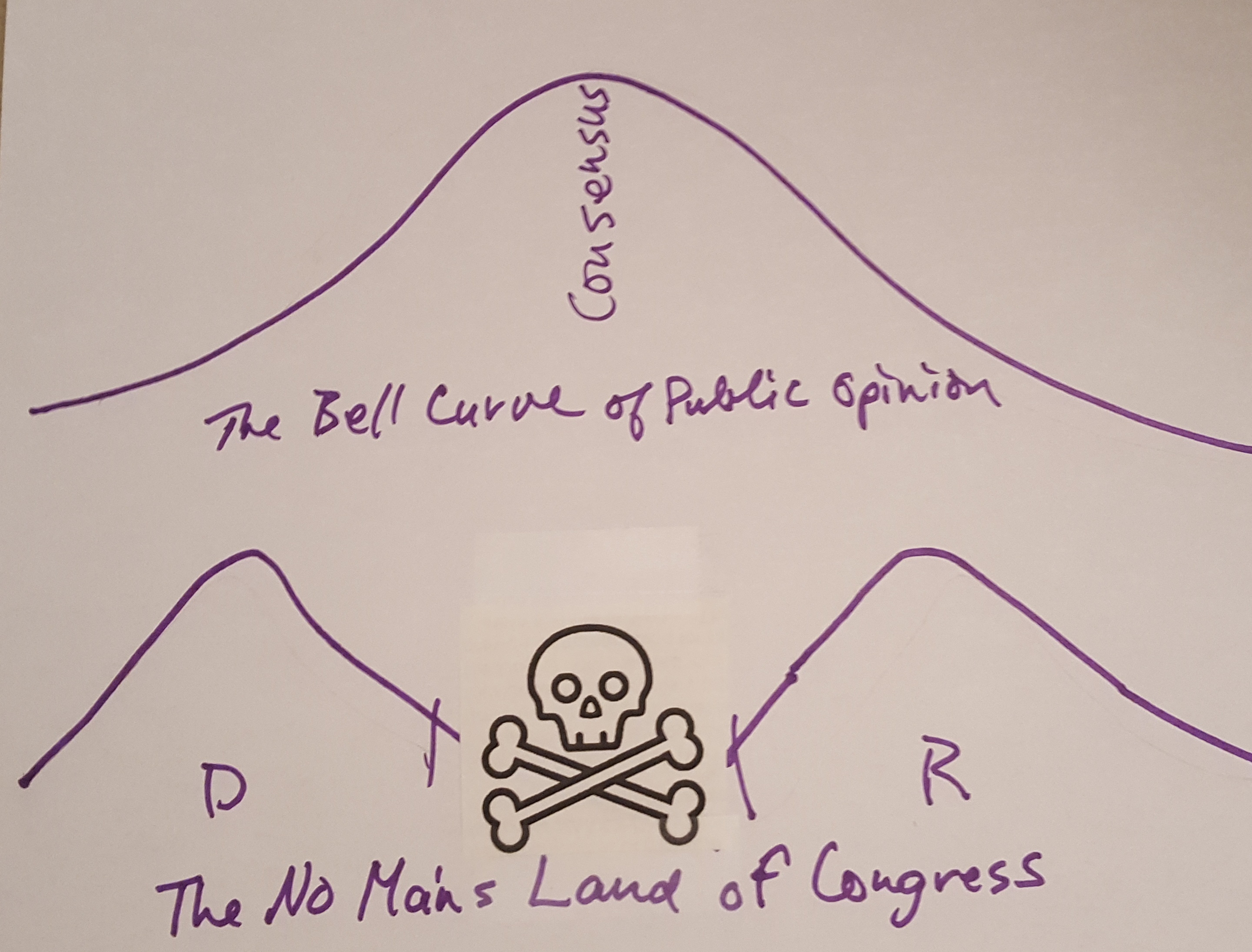
What does it take to fight corruption? Unity. The vast majority of the American populace are on the top of the bell curve of public opinion in the middle. Out positions on many issues is the same. We have the same hopes and fears. In a divided Congress, that middle ground is No Man’s Land. You will get shot for going there. If we’re polarized and divided, the larger forces that are really corrupting and stealing from our society win. If the government for the people is paralyzed (the GOP’s goal: dismantling the Government), the top one percent get to operate with impunity, without guard rails, to the detriment of we, the people. Division means we, the people, lose. It keeps us focused on the wrong things so the big things go unaddressed.
Corruption saps the strength of a society through pulling the riches out of the economy to be collected in the wealth and power of a few at the top. Hoarding is a human tendency that government needs to protect against. Capitalism is neutral on human hoarding. This is not restricted to countries, but effects the global economy. Returned Peace Corps volunteer Sarah Chayes wrote intelligently about this in her book Thieves of State: Why Corruption Threatens Global Security after witnessing how corruption made it impossible to do development work in Afghanistan after the wars there.
These are entrenched systemic issues. Corruption is at the bottom or heart of all of it. Corruption includes the SCOTUS decision in Citizens United and many that have followed—a number in the last few years that will fundamentally corrupt our society beyond redemption.
There’s some sense about the populace of, “Don’t confuse me with details. I don’t care how he does it, but he’s headed in the right direction.” The boring, important structural work of governing is not easy to use to motivate voters compared with mistrust of the other guy and fear. Maybe we shouldn’t hold politicians to their campaign promises. The things you have to say to get elected are not necessarily the things we want a president to do in office. I feel that way about Harris. I don’t necessarily like all the policies, but at least we get to keep arguing about it in a democracy. And her heart is in the right place. The rest is negotiation and doing the quiet work.
Thanks for sharing your insights, Linda. I struggle with understanding the basis of our current polarization, and your analysis is food for thought.
A good read. I reflected on a bunch of stuff as I read. I live in daily dread and know that I will have a strong, viseral reaction if Harris doesn't win - wondering about my expat status. Please let decency and democracy prevail!