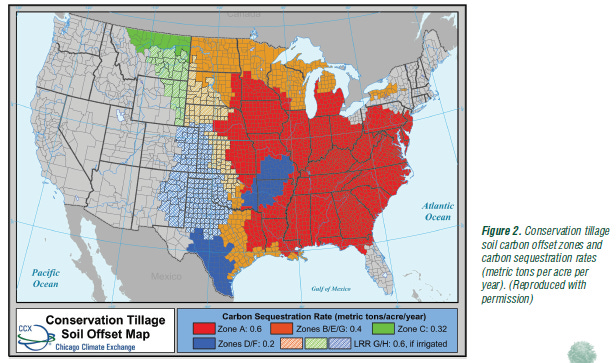
Chicago's private carbon credit market: in 2011 it was interesting to see the beginnings of an infrastructure for trading carbon sequestration/emissions as a commodity develop. At this point the money is not much, but still, it's incentive in the right place. The paragraphs below from the Purdue University Extension brochure (http://www.extension.purdue.edu/extmedia/FNR/FNR-228-W.pdf ) put it pretty well, I think. As I've heard it explained in seminars for farmers, it's like the tail that the dog wags rather than the tail wagging the dog. It's a little bit of money to help, if you're already moving in the direction of conservation practices anyway.
It is hard to think about conserving and saving the planet in any meaningful way on such a small scale as our 140-acre family farm. But you can think about putting our piece of the puzzle together with other landowners whose waterways make up a watershed, or patching together your 10 acres of managed forest with other landowners to form an aggregate for trade, or providing a patch of habitat that might tip the balance for a stressed species. If you can put the farm in a bigger context--a bigger vision for the State of Indiana or the country--and a longer time scale--a vision for the future out beyond our generation, say 50 years, then you can start to see larger meaning. It’s like looking at the mud-colored splotches that comprise the bust of Kennedy in the Kennedy Center. Only from a distance can you see Kennedy’s face in the brilliant sculpture.
Brochure exerpt:
The sale of carbon sequestration offset credits compliments existing conservation programs that provide financial and technical assistance for conservation plantings and sustainable land management. The Conservation Reserve Program (CRP), Environmental Quality Incentive Program (EQIP), forest property tax incentive programs, and certification systems such as the American Tree Farm System, Forest Sustainability Council, or Sustainable Forestry Initiative are examples of programs that could be paired with selling carbon offset credits as part of a management strategy.
An attractive aspect of this new market place is the opportunity for landowners who have practiced good land stewardship to be rewarded financially for their activities. Although the financial rewards at this time are not large, it is an extra revenue source that can provide an additional incentive to install and maintain these beneficial practices.