

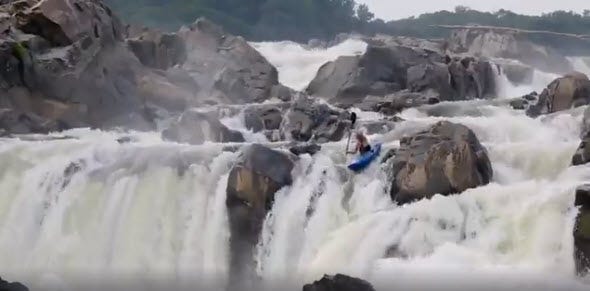
I have been pondering a scene I witnessed awhile back. I'm not sure why this image has come to represent a profound metaphor for me lately, but it seems helpful during our turbulent times.
It was a cold, wet February, above freezing, but not by much. The day was cloudy, misty, drizzly, and gray. A friend and I decided it was the perfect day for a hike--on the easy part of the Billy Goat Trail outside Washington, D.C. that took us to the boardwalk along the Potomac River with views of Great Falls from the Maryland side (rather than Virginia Great Falls park). The river was as furious as I'd ever seen it that day. Rain had fed the river from all directions, and the spray of the waves crashing was tremendous, adding drama to the always spectacular falls.
As we stood on the boardwalk platform, watching the spectacle, into the scene came bobbing four colorful kayaks. We were stunned to see kayakers on the river that day. Dangerous at any time of year, Great Falls had been successfully navigated only in 1975. On a regular day, the Potomac contains one of the steepest kayak runs in the world--a 60-ft drop in 60 seconds. It ranks in the top class of difficult whitewater.[1] The kayakers were wearing black wet suits, but it was beyond my imagination to think about getting into that cold water in the violent state it was in.
I know that kayakers have very specific and specialized terms for all manner of water features, but I don't know them. I'm guessing you don't either. I'll give them approximate descriptions. The kayakers had collected in an eddy to the side of the main flow of the river that formed a calm pool. They were apparently collecting themselves for a run over a waterfall into a churning whirlpool. One by one, the kayaks approached and tipped over the lip of the falls going vertically about the length of the kayak, submerging into the churn below the falls. The kayakers resurfaced and paddled their way out of the spinning vortex and over rapids to another calm spot on the other side of the river while the next one went. But the last kayak entered the falls backwards, turned around by the current before entering. The kayak dropped vertically into the churning water below the falls. When it bobbed back up, it was upside down. We only saw the bottom hull of a kayak trapped by the whirlpool of water churning below the falls. That hull stayed stranded upside down below the falls for what seemed like minutes to us. We started to panic, afraid we were watching another drowning death at Great Falls. Then, in another moment, the kayak started moving down the river, still upside down. We walked down the boardwalk platform following it. As it drifted to where the other three kayaks were floating alongside the river, finally, it righted itself and the paddler joined the other kayakers. My heart was pounding by that time, but I was so relieved.
As it turned out, members of the group portaged down river not far from where we were. They came out of the river on our side with their kayaks and carried them up near us for running the side inlets by the board walk. The final kayaker took a break and joined us on the boardwalk to watch the others for a while. We learned from him that the group included visitors from California, who had come just to run the Falls.
He explained how he navigated the situation we witnessed. That level of kayaking requires intimate knowledge of the way of water, and not fear. The Tao is the water way, and I think a similar sanguinity and centered calm is required to dance with the force of the river. Kayakers at this level have to be strong, certainly, but more, they need to be familiar with the water features like the character of family members and what tricks those features contain and mitigations those features require. They'd have to understand how to read and be one with the interlacing currents to take advantage and make the flow work for them or they with it. They'd need to know what to do in situations like we witnessed--how you work with the force of water to NOT smash into rocks (being in the water that is going around the rocks) or escape a whirlpool, to find and use the currents that save and protect and avoid or get out of the way of the ones that damage.
When trapped in a tumultuous churn that can't be fought on a human scale, upside down, underwater, and not able to breathe, this kayaker had to reach down (which to the underwater upside down person would be to reach up over their head) with the paddle into a current that is flowing downstream with the major mass of water--to tap into a different flow than the flow trapping the kayak under the waterfall.
The metaphor, for me lately, has provided a guide for the feeling, which seems to match the times, of being underwater, overwhelmed, and not knowing which way is up, being in the midst of turmoil and not knowing which way to go. The image that stays with me is the idea of blindly, and in faith taught by long competence, of reaching overhead with your paddle for "higher" water, the flow that will get you unstuck and moving on down the river. So in any moment when I am feeling overwhelmed or exhausted and a little lost, I think about feeling stuck in the crosscurrents and just taking a breath, getting calm and reaching up (or down) out of the turmoil for a calm flow that is traveling in the right direction to carry me.
We can't control the larger forces in our life. But we do have some agency in the currents that buffet us. We can try to fight them, if we can discern them, but it's a losing battle. We can "go with the flow," letting the currents take us where they will, and always ending where the river meets the sea. Or we can work on harnessing the powerful currents to jet us forward in life, not get stuck in the eddies, ride the waves of our choosing. There is risk and danger in being intimate with that fundamental force, but what a ride if it can be mastered!
[1] https://www.washingtonpost.com/sports/highschools/great-falls-a-breeding-ground-for-top-level-competitive-kayakers-on-the-potomac-river/2014/07/03/320b45c4-fcf9-11e3-8176-f2c941cf35f1_story.html
Thanks for posting, Linda. I always find your essays to be thought-provoking, and usually, poetic as well. I like this metaphor of reaching down (or up) to a different flow when caught in turbulent conditions, and not panicking!