


What a fortuitous coincidence it was that the name of the couple responsible for the overturning of state laws against inter-racial marriages was Loving.
Richard Loving and Mildred Jeter married in rural Virginia in 1958. Richard was White. Mildred was Black and Native American. Their marriage was illegal in Virginia under the 1924 “Racial Integrity Act” criminalizing marriage between white and non-white persons.
Later that year, the Lovings were dragged out of their home in the middle of the night, arrested, convicted, and banished from Virginia.
Inter-racial marriage wasn’t illegal everywhere, and the couple were able to live together in Washington, D.C. But they were not able to visit friends and family in Virginia. They weren’t activists, but in 1963 they decided they weren’t willing to live under those conditions, which they considered morally wrong.
They wrote to the U.S. Attorney General. In 1963 that was Robert F. Kennedy. He referred them to the American Civil Liberties Union. The ACLU carried their suit to the Supreme Court, where lawyers defending the ruling of the Virginia State Supreme Court argued that “marriage has traditionally been subject to state regulation without federal intervention, and, consequently, the regulation of marriage should be left to exclusive state control by the Tenth Amendment.”
Ah, that old states rights argument. “Federalism” is one of the strengths of our system of government. In the United States, power is constitutionally divided between the national government and individual state governments. Federal and state governments each have distinct but interconnected spheres of authority. The federal government declares war, regulates interstate commerce, levies taxes, maintains the army for national security. State governments generally control education, the running of elections, public health, and criminal justice within the state.
The Supremacy Clause of the Constitution states that federal laws are supreme over state laws, but states can exercise powers not explicitly given to the federal government (given to the federal government by itself, I might add), which is the Tenth Amendment to the Constitution. Powers not explicitly delegated to the federal government and not prohibited from the states belong to the states or to the people. States can make laws that are different (more or less strict) than federal laws, but they can’t contradict federal law. Federalism acts as a check on the power of the federal government, and it also allows states to experiment with different policies.
There is a legitimate tension to the balance of power between the federal government and states’ autonomy. It’s a dynamic balance that goes through constant tests. Our system of government is not a static system. It is constantly changing, evolving, and adapting. Also, federal and state governments can work together for the greater good, cooperative federalism, like on issues of public education, transportation, and infrastructure. This all makes sense.
When the Supreme Court took on the Loving case, the Warren Court rejected the states right argument. Justice Potter Stewart wrote, “I have previously expressed the belief that it is simply not possible for a state law to be valid under our Constitution which makes the criminality of an act depend upon the race of the actor.”
The Warren Court issued a sweeping ruling that overturned all state statutes prohibiting interracial marriage in the 1967 U.S. Supreme Court decision, Loving v. Virginia. That ruling declared all state bans on inter-racial marriage unconstitutional.
One year before she died, Mildred Loving issued a statement supporting gay marriage, too, which was still illegal.
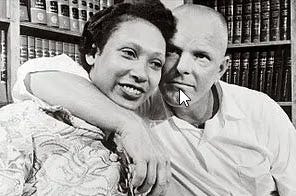
On the fortieth anniversary of the Loving decision in 2007, she wrote, “Surrounded as I am now by wonderful children and grandchildren, not a day goes by that I don’t think of Richard and our love, our right to marry, and how much it meant to me to have that freedom to marry the person precious to me, even if others thought he was the ‘wrong kind of person’ for me to marry.
“I believe all Americans, no matter their race, no matter their sex, no matter their sexual orientation, should have that same freedom to marry. Government has no business imposing some people’s religious beliefs over others. Especially if it denies people’s civil rights. I am still not a political person, but I am proud that Richard’s and my name is on a court case that can help reinforce the love, the commitment, the fairness, and the family that so many people, black or white, young or old, gay or straight seek in life. I support the freedom to marry for all. That’s what Loving, and loving, are all about.”
Thanks for the reminder, Linda! Now that you mention them, the Lovings' story is familiar, but I had no idea when their wedding anniversary was. In many ways, it feels like we have continued to make progress since their legal struggles. But in other ways, it feels like we are backsliding. Stay strong, and LOVING!