

Any mother who has snatched up little ones making a beeline straight for the richest, darkest mud can tell you about the attraction mud holds for children. Mud baths notwithstanding, somewhere in growing up it may lose its fascination and just become dirt. But not for some of us.
Dr. Patrick Drohan, Director of the Pennsylvania State Soil Characterization Laboratory in University Park, Pennsylvania, is a champion of soil. He can weigh the composition of a soil by squeezing it in the palm of his hand and smelling its rich loam. And you don’t have to be a farmer to appreciate the rich aroma of turned earth in the first spring rains. For Drohan and his like, if bread is the staff of life, soil is the foundation on which that staff leans.
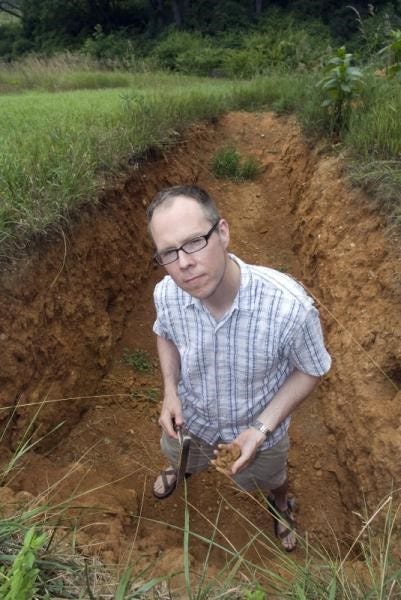
Drohan is passionate about the importance of soil and its protection. His classes at Penn State University often convene around the “pit,” a 4-ft deep by 4-ft wide trench dug into the earth to expose the elements that compose the soil. Standing in this living laboratory waist high in sandals with dirt in hand, the young man’s quizzical, bespectacled look belies the intensity that has driven him to soil sites around the country and abroad.
Drohan asserts, "Just as we lose animal and plant species to extinction, we also are seeing soils damaged or destroyed…, which can put life at risk." Life as we know it, that is. “Virtually everything we do each day depends on soil.” An assistant professor of pedaology (the study of soils in their natural environment) in the Department of Crop and Soil Sciences, Drohan researches soil creation and classification and, in effect, the death of soils damaged by human activities. Drohan created a top 10 list of reasons people might care about the importance of soil from clothing, shelter, and food to, more subtly, the clay in milkshakes, antibiotics from soil organisms, filtration of drinking water, and trapping carbon in our planet’s critical carbon cycle.
The battlelines to save soils in Pennsylvania lie in threats from land development and industries like mining for extraction of fuel (coal, gas, oil) from the land. “Technology we have today can do things much quicker to a soil—good and bad,” says Drohan. Large-scale operations can cause vast disturbances in the natural cycle of soil creation and decomposition. Urban sprawl, too, can mean less revitalization of soil and more surface run off than forest soils. Soil can erode from floods, too, but Drohan says destruction by man’s activities has far surpassed natural events.
Drohan hopes categorizing and identifying rare and threatened types of soil can help define the indefinable value of soil. He has proposed a schema for classifying soil types based on five values: economic, ecosystem, scientific, historic/cultural, and rarity.
In Pennsylvania, Drohan has identified serpentine soils (Chrome series) that occur along the state line between Pennsylvania and Maryland as a threatened soil with value for its unique ecosystem and rarity. The soil over a light green serpentine bedrock is dry and poor in nutrients with high levels of the heavy metals nickel and chromium. While toxic to many plants and animals, this minerology supports rare and endangered species that have adapted to the soil including the Serpentine aster, Symphyotrichum depauperatum, which grows nowhere else in the world. Its unique ecosystem—determined by characteristics such as hydrology (water flow-through), mineralogy, and organic matter content—also supports a rare nickel-resistant bacteria. These bacteria might represent a unique biology-based solution to pollution that would be lost with the loss of this soil type.
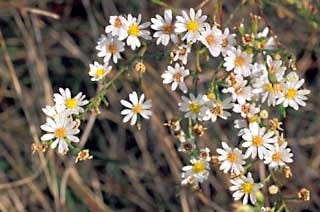
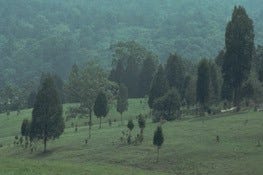
The Serpentine Barrens are some of the last remnants of grassland of its type in eastern North America, and in fact, the Serpentine Barrens have been the object of conservation efforts by the Nature Conservancy since 1979.
This is the perfect application in Drohan’s vision. He would like to see soil protected in the same tradition of protecting endangered species and protecting clean air and water, but perhaps more in the way of education than with legal ramifications to start. In Drohan’s concept, the labels would not be legally binding, but draw the attention groups such as land-use planners or conservationists to particular threatened soil types. Recognizing soils as in danger, people can track their change over time and focus soil conservation efforts to take another direction.
The Nature Conservancy joined with Pennsylvania’s Chester Country to oppose the quarrying of serpentine rock near the Goat Hill Barrens. Some of that lands was then acquired and transferred to the state for a rare plant preserve. The Conservancy also owns and manages the Chrome Barrens nearby and has an agreement with Nottingham County Park in Chester County to preserve the unique barren habitats.
Native Americans used fires and grazing to manage these serpentine grasslands. The serpentine aster and round-leaved fameflower, true succulents like cactus, tolerate heat and drought by storing water in stems and pads. The serpentine aster has almost no leaves on its red flower stalk and hugs the ground to resist heat and drought. The Nature Conservancy researches and applies best methods to restore the soil habitat and ecology. It also uses fire and grazing, as well as mechanically removing humus (bulldozing) to restore prairie and savanna habitats in the Chrome Barrens, which are open to the public for nature and recreational activities.
How valuable are these soils? President Franklin Delano Roosevelt appreciated that, “The nation that destroys its soil, destroys itself.” During the 1930s, the Dust Bowl of the great planes in the Midwest and the Great Depression awoke the nation to the relationship between poverty and poor land use. In signing the Soil Conservation and Domestic Allotment Act, Theodore Roosevelt wrote, “The history of every Nation is eventually written in the way in which it cares for its soil. The United States…is beginning to realize the supreme importance of treating the soil well.”
It is difficult to measure the loss field by field. But the trend in destruction of soils is disturbing. “How many more variables do you need before a situation arises where you’ve gone too far?” queries Drohan.
This article first appeared in Lancaster Farming, Saturday, December 27, 2008.
Thanks for sharing this timeless article, Linda. Coincidentally, I was just reading today that one of my favorite foods, the cacao bean (aka cocoa nibs, 100% cacao baking chocolate, etc.) picks up cadmium and lead from the environment. So even though it has many nutritional benefits, it also carries the threat of heavy-metal contamination! The rare nickel-resistant bacteria in Pennsylvania's serpentine soils is especially intriguing to me as a potential biological weapon against heavy metals in soil.